Few people know it, but behind the image of a free and independent browser, Firefox lives thanks to substantial financial support from Google. For almost twenty years, a commercial agreement has united the two companies, guaranteeing Google’s place as the default search engine. This astonishing partnership, both strategic and necessary, ensures Mozilla’s long-term survival, while enabling it to retain its technical autonomy and its vision of an open web.
The Firefox browser is largely financed by Google
- A long-standing partnership between Mozilla and Google
- The web needs Firefox for Chrome to innovate
- The domino effect of antitrust cases for Firefox
A long-standing partnership between Mozilla and Google
The collaboration between Mozilla and Google dates back to the early days of Firefox, when the web was largely dominated by Internet Explorer. The Mozilla Foundation, created to defend an open and accessible Internet, needed to find a business model capable of supporting the development of a free browser. In 2004, an agreement was reached with Google to make its search engine available by default in Firefox. This seemingly simple arrangement quickly took on a strategic dimension.
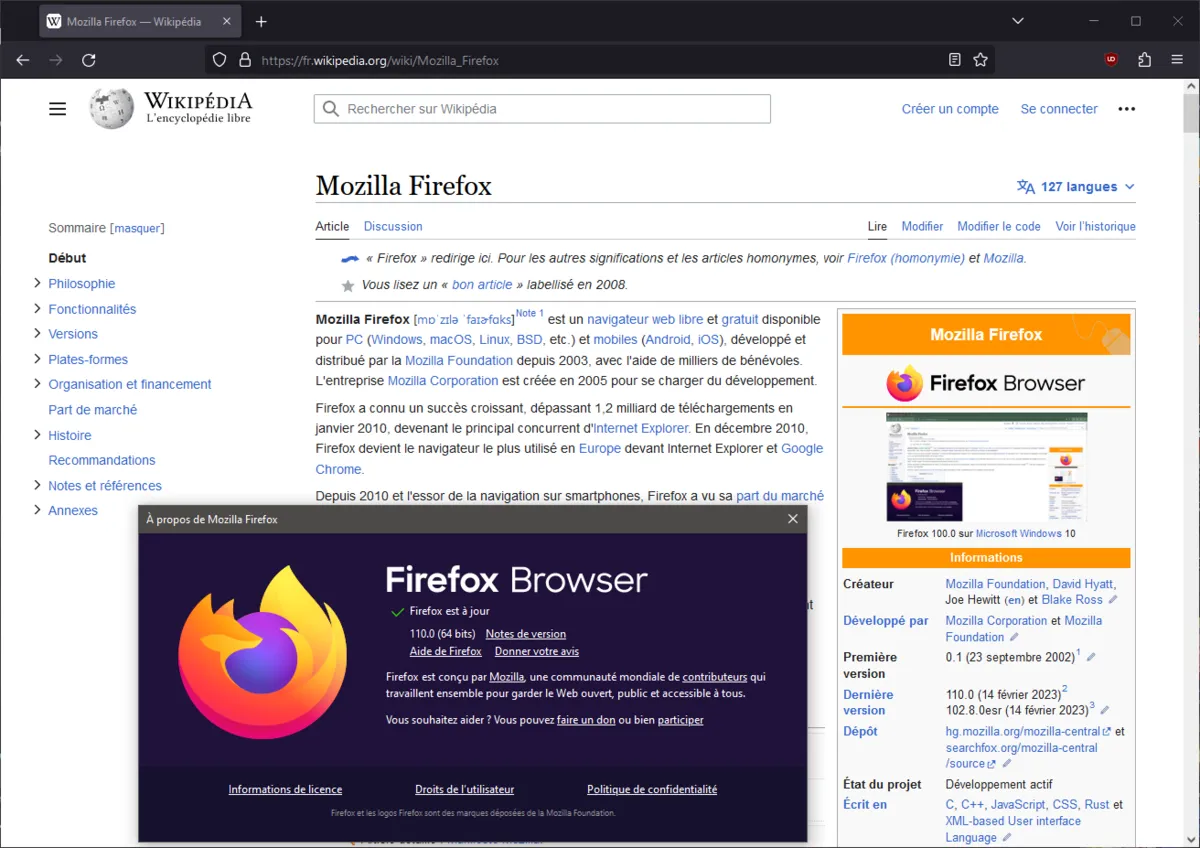
It enabled Mozilla to ensure the continuity of its project while maintaining totally independent governance. Since then, the partnership has been renewed several times, with amounts estimated at between $400 and $450 million per year. Today, this funding remains the foundation’s main resource, and is one of the pillars enabling Firefox to continue its evolution in the face of the web giants.
Maintaining independence despite Google funding
Google does not own any shares in the Mozilla Foundation or its commercial subsidiary. The agreement between them is purely contractual, with no capital ties or direct influence on browser governance. Mozilla therefore retains complete freedom of choice, and can decide at any time to change its default search engine, as it has already done in the past with Yahoo or Bing in certain countries. Should the partnership come to an end, Firefox will not disappear. The browser would continue to function and the foundation would pursue its mission, even if it would have to fundamentally rethink its financing to maintain sustainable development without Google’s economic support.
Find out how to set Google as your browser’s default search engine.
The web needs Firefox for Chrome to innovate
Firefox occupies a unique place in the web ecosystem. By ensuring compatibility with systems considered old-fashioned, it guarantees millions of computers uninterrupted access to the Internet. This presence is not only beneficial for its users, but also for Google. If all browsers were based on Chromium (the Chrome engine), a large proportion of the world’s computers would be excluded, unable to display modern sites. Keeping Firefox allows Google to pursue its own logic of innovation without the constraint of universal compatibility.
| Criteria | Firefox | Google Chrome |
|---|---|---|
| Rendering engine | Gecko (Mozilla proprietary) | Blink (derived from WebKit) |
| Update cycle | Stable + long-term ESR version | Frequent updates and rapid end of support for older OSes |
| System compatibility | Still works on older Windows and Linux distributions | Quickly ends support for obsolete systems (Windows 7, 8, 10) |
| Support duration | ESR versions maintained for at least 1 year after each release | Rapid end of support after system shutdown by Microsoft |
| Priority | Priority to stability and universal accessibility | Priority to security, speed and integration of new APIs |
This allows Chrome to focus on performance, security and the rapid integration of new web standards. By freeing itself from the burden of obsolete systems, it moves faster, introduces more secure technologies and improves the browser’s overall responsiveness. Meanwhile, Firefox ensures technical continuity, preserving the diversity of the web and maintaining a bridge between generations of systems. This complementarity illustrates how two opposing approaches can coexist to advance the web without excluding users.

The domino effect of antitrust cases for Firefox
Antitrust investigations against Google in the USA and Europe have highlighted the tension between the power of a dominant player and the need to preserve an open ecosystem. The authorities accuse Google of having maintained its quasi-monopolistic position in online search through distribution agreements with device manufacturers and browser publishers such as Mozilla. U.S. judge Amit P. Mehta confirmed that these practices had limited competition, while acknowledging the difficulty of imposing remedies that do not harm partners dependent on these revenues.
For Mozilla, the situation is particularly delicate. Its agreement with Google ensures the financial survival of Firefox while maintaining the diversity of rendering engines. If an antitrust ruling were to restrict or prohibit these contracts, the foundation would lose a vital resource. This scenario, designed to limit Google’s dominance, could weaken one of the few browsers truly independent of the Californian giant. The authorities must therefore arbitrate between the desire to re-establish competition and the risk of destabilizing an essential counterweight to technological concentration.
These cases reveal the complexity of an ecosystem where economic dependence coexists with ideological independence. Removing Google’s funding for Mozilla would be tantamount to weakening a player that still guarantees a plurality of technical and philosophical approaches to the web. Conversely, allowing these exclusive agreements to continue unchecked would consolidate Google’s dominant position. Between these two extremes, regulators seek to preserve diversity without stifling innovation, and maintain a web where competition remains possible without stifling those who still embody its original spirit.
Did you find this article helpful?
Share it so others can benefit from it.
Learn more about the author