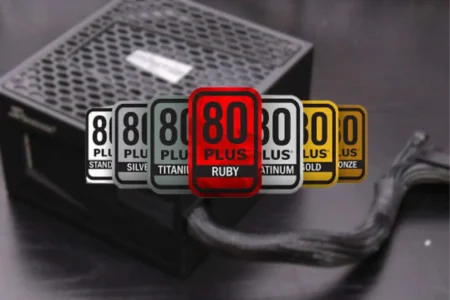
The 80 PLUS label is evolving. Known for classifying the energy efficiency of power supplies for nearly 20 years, the programme now includes a new level: 80 PLUS Ruby. Designed to meet the growing energy needs of data centers, cloud servers, and AI infrastructure, this standard sets new performance thresholds. Here is what this discreet yet strategic development changes.
 assistouest.fr
In this article
What Is the 80 PLUS Ruby Certification?
80 PLUS Ruby is the latest evolution of the energy-efficiency classification programme for PC power supplies (PSUs), which was originally created to measure and certify their efficiency. It sits above the Platinum and Titanium levels, requiring even higher efficiency, including at low loads. Unlike other 80 PLUS certifications, which are often associated with consumer products and workstations, Ruby targets redundant power supplies used in data centers for critical workloads such as AI, cloud computing, and high-performance computing (HPC).
This new level of requirements is driven by CLEAResult, the organization responsible for the 80 PLUS programme. Already known for its rigorous standards, CLEAResult introduced Ruby to address a clearly identified issue: the low efficiency of PSUs at very low loads (5–10%), a common scenario in modern infrastructures operating in an active standby state or under variable loads. With Ruby, the goal is to maximize efficiency across the load range, limit thermal losses, and improve the energy economics of large-scale infrastructures.
| Load (%) | Minimum required efficiency | Minimum power factor (PF) |
|---|---|---|
| 5% | 90% | ≥ 0.90 |
| 10% | 91% | ≥ 0.90 |
| 20% | 95% | ≥ 0.96 |
| 50% | 96.5% | ≥ 0.96 |
| 100% | 92% | ≥ 0.96 |
These results must be achieved at standard voltages such as 230 V, 277 V, and 480 V AC, or 380 V DC.
80 PLUS Ruby therefore represents a new energy-efficiency standard for power supplies intended for data centers. It helps reduce energy consumption and operating costs.
80 PLUS Ruby vs. Titanium: What Are the Practical Differences?
80 PLUS Titanium long represented the highest level of energy efficiency for professional power supplies. With the arrival of 80 PLUS Ruby, however, the bar has been raised, especially at low loads—a known weak point for PSUs in server environments. Ruby requires higher efficiency from just 5% load, while also imposing stricter power-factor criteria to limit losses and ensure a stable power supply in data centers.
| Load | Titanium | Ruby |
|---|---|---|
| 5% | 90% | 90% (PF ≥ 0.90) |
| 10% | – | 91% (PF ≥ 0.90) |
| 20% | 94% | 95% (PF ≥ 0.96) |
| 50% | 96% | 96.5% (PF ≥ 0.96) |
| 100% | 91% | 92% (PF ≥ 0.96) |
This higher standard is driven by new use cases: cloud infrastructure, AI, and virtualization, which often run power supplies at variable loads. Ruby is specifically designed for redundant power supplies and the complex electrical conditions found in modern data centers. The table below illustrates the threshold differences between Titanium and Ruby.

Who Is the 80 PLUS Ruby Certification For?
80 PLUS Ruby was designed specifically for redundant power supplies in data centers where service continuity is essential. These power supplies are installed in pairs (N+1 or 2N) to ensure fault tolerance. Such systems frequently operate at partial load, a scenario in which Ruby delivers a clear efficiency gain. By requiring high efficiency from 5% load, the standard significantly reduces electrical losses even when servers are not running at full capacity.
We allow some readers to view our articles for free with an ad blocker. However, their number is currently too high for us to keep this access available to everyone.
You can disable your ad blocker to continue reading immediately, subscribe to enjoy all our content without ads, or come back a little later when the pressure has eased.
Access will be restored automatically as soon as the situation allows.