
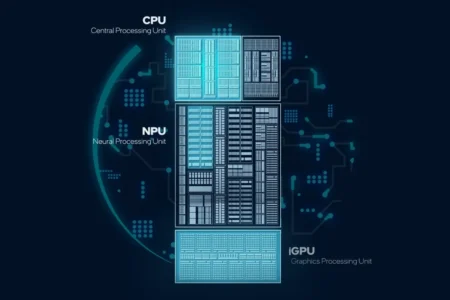
Modern processors increasingly use heterogeneous architectures. Where a CPU once handled every calculation, it is now accompanied by specialised units, each optimised for a particular task: graphics and multimedia through the iGPU, and artificial-intelligence workloads through the NPU. Integrating an NPU into a processor is a logical extension of this hardware specialisation.
A CPU with an NPU therefore combines general-purpose computing cores with a unit dedicated to local AI-model execution. The NPU does not replace the CPU or GPU: it complements them for targeted operations designed to run efficiently and with controlled power use.
In this article
What is an NPU, how does it work, and what is it used for?
An NPU (Neural Processing Unit) is a specialised compute unit for artificial-intelligence processing. Unlike general-purpose CPU cores, it is optimised for the repetitive mathematical operations used by neural networks and matrix calculations. Its primary job is to speed up these operations while reducing energy consumption.
In practice, an NPU is mainly used for inference: running an already trained AI model. It can handle image recognition, audio processing, video enhancement and some system-assistance features. The NPU works alongside the CPU and GPU, each of which keeps its own preferred workload.
An NPU is not intended to replace a GPU for heavy workloads or to train complex models at scale. Its scope is deliberately focused on efficient local AI processing.
| Unit | Main role | Calculation type | Typical uses |
|---|---|---|---|
| CPU | General computing and orchestration | Sequential logic and multitasking | Operating system, applications, overall management |
| NPU | Artificial-intelligence processing | Neural-network inference | Local AI, image, audio, assistants |
| iGPU | Integrated graphics processing | Parallel graphics computing | Display, video, graphics acceleration |
The NPU as an extension of the CPU
The NPU follows the evolution towards processors made up of several specialised units. It is not a new kind of CPU: it does not replace general-purpose cores or alter their fundamental role. The CPU remains responsible for general tasks, application logic and system orchestration, while the NPU is called on for AI-specific processing.
At hardware level, the NPU is integrated into the same silicon package as the CPU. The units share some resources, including memory access and internal buses, while retaining separate execution paths. This allows fast communication and efficient workload distribution according to the task.
The NPU does not raise raw CPU performance. Instead, it improves efficiency in specific AI scenarios. Moving AI work to a dedicated unit leaves the CPU and GPU less busy and can improve overall responsiveness. On mobile devices and laptops, this specialisation also controls power consumption and can improve battery life when AI tasks run continuously.
TOPS: a theoretical AI-performance indicator
TOPS, or trillion operations per second, describes an accelerator’s theoretical ability to process a very large number of operations in one second. For an NPU, it mostly quantifies maximum throughput on simple, repetitive neural-network calculations. Published figures usually use reduced precision such as INT8, which is widely used for inference. Lower precision lets the chip perform more operations per cycle while retaining sufficient quality for many everyday AI uses.
TOPS values are consequently tied to quantised models. Models designed for NPU execution use compressed weights and lower precision to reduce consumption and improve efficiency. TOPS reflects peak capacity in optimised inference, not general performance across every possible AI workload.
INT8: the most common precision used for TOPS
Manufacturers almost always quote INT8, calculations using 8-bit integers. It currently offers a good balance between throughput, power consumption and inference accuracy. It reduces model size substantially and permits many more operations per cycle than floating-point precision, with adequate quality for most consumer uses.
Some figures may also include INT4 or similar hybrid formats, although this is less systematic and less well documented. FP16 and FP32 are rarely used to advertise NPU TOPS because they yield lower numbers and are more relevant to GPUs or training workloads.
TOPS figures are therefore not always comparable between processors. They depend on precision, the operations counted and test conditions. Two NPUs with similar TOPS can produce very different results depending on the model and software support. TOPS alone is useful for positioning a platform, but insufficient for judging real NPU effectiveness in advanced use.
Don’t let the algorithm decide for you
Add Assistouest to your preferred sources on Google so you can find our guides faster when you search for an IT solution.
Why do AI workloads need a dedicated unit?
AI workloads mainly contain repetitive mathematical operations—matrix multiplication and vector addition—used by neural networks. They are predictable and highly parallelisable but not very flexible, which makes them a poor fit for general-purpose CPU cores designed for a broad range of instructions and complex logic flows.
A GPU can handle these calculations, but it is optimised for sustained heavy workloads. For small AI tasks that run frequently, such as audio and video processing or background analysis, activating it can quickly raise system load and power consumption. That is disproportionate on a laptop when the AI workload is modest.
Because it is specialised for these calculations, the NPU can run local AI tasks much more efficiently. Without one, even modest AI work can heavily use the GPU and increase consumption without a matching functional benefit. For the other integrated compute unit in modern processors, read our explanation of what an iGPU is.
The content will unlock automatically after verification.
An error occurred. Please try again in a moment.