
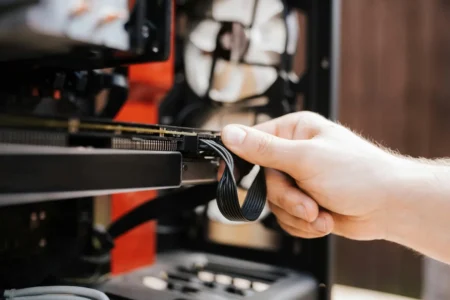
A dedicated graphics card is no longer essential for gaming. AMD APUs (Ryzen 8000G) and Intel Core Ultra processors include iGPUs capable of running LoL, Valorant, CS2 and Rocket League above 100 FPS without a separate GPU.
An APU (Accelerated Processing Unit) is a processor with a GPU integrated directly into the same chip. AMD uses this term for its Ryzen processors with RDNA iGPUs. If you want to understand how an iGPU works, we cover the subject in a separate guide.
In this article
Which games run on AMD and Intel chips?
On the AMD side, the Ryzen 5 8600G (Radeon 760M, 8 RDNA 3 CUs) exceeds 100 FPS in popular games at 1080p with medium settings. The Ryzen 7 8700G (Radeon 780M, 12 CUs) reaches 80 to 110 FPS in competitive games and 50 to 80 FPS in AAA games at 1080p on low settings.
On the Intel side, Core Ultra 200S processors (Arrow Lake, Arc Graphics with 4 Xe cores) are more limited. The Core Ultra 9 285K iGPU is roughly on the level of a GTX 1050 Ti: enough for gaming, but borderline for AAA titles. Intel’s real breakthrough will come with Core Ultra Series 3 (Panther Lake, late 2026), which will include an Arc B390 capable of 99 FPS in Cyberpunk 2077 at 1080p medium with XeSS, and up to 160 FPS with Frame Generation. This chipset is not yet available for desktop PCs at the time of writing.
| Processor | iGPU | AAA 1080p low |
|---|---|---|
| Ryzen 5 8600G | Radeon 760M (8 RDNA 3 CUs) | 30 to 50 FPS |
| Ryzen 7 8700G | Radeon 780M (12 RDNA 3 CUs) | 50 to 80 FPS |
| Core Ultra 9 285K | Arc Graphics (4 Xe cores) | 20 to 35 FPS |
| Core Ultra Series 3 (late 2026) | Arc B390 (Xe2) | 60 to 99 FPS |
These figures apply to systems with 16 GB of DDR5 in dual channel. With 8 GB in single channel, performance drops by 20 to 30%. RAM is one of the main performance levers for an iGPU.
System memory determines your gaming performance
An iGPU has no dedicated VRAM. It uses part of the system RAM to store textures and graphics buffers. Memory bandwidth becomes the limiting factor, rather than the number of graphics cores.
I regularly see Ryzen 7 8700G systems fitted with a single 16 GB stick in single channel producing fewer FPS in LoL than a Ryzen 5 8600G with two DDR5-6000 sticks in dual channel. Moving from DDR5-4800 to DDR5-6000 in dual channel delivers 10 to 18% more FPS on a Ryzen 8000G. Knowing how to choose the right RAM makes all the difference here: two identical sticks in dual channel are the bare minimum. Using only one slot means losing 25 to 30% of your graphics performance.
Games that run well and games that struggle
Games with lightweight engines are where modern iGPUs shine. League of Legends, Valorant, CS2, Rocket League, Minecraft Java, Stardew Valley and Hades all run at 1080p without a visible compromise to competitive gameplay, both on Ryzen 8000G and Intel Core Ultra 200S systems.
Recent AAA games require dropping to 1080p low and enabling upscaling. With FSR 3 (AMD) or XeSS 3 (Intel), you can recover 30 to 40% more FPS in supported titles. Cyberpunk 2077 runs at 45 to 60 FPS on a Ryzen 7 8700G at 1080p low with FSR, according to LanOC Reviews measurements. That is playable, but not at Ultra settings.
The games that struggle are those requiring more than 6 GB of dedicated VRAM, games with ray tracing (iGPUs run it at unusable frame rates), and poorly optimized PC titles that do not support upscaling solutions.
AMD or Intel for gaming without a graphics card?
For desktops today, AMD is ahead. The Ryzen 7 8700G (Radeon 780M) outperforms the Core Ultra 9 285K iGPU in games at a similar price. Arrow Lake (Core Ultra 200S) has only 4 Xe cores in its iGPU, limiting its gaming ambitions beyond light eSports.
The Core Ultra 5 250K Plus (Arrow Lake Refresh) exceeds the Steam Deck in graphics performance, according to Hardwarecooking.fr measurements. Intel is catching up but remains behind AMD APUs for desktop gaming. Panther Lake (Core Ultra Series 3, Arc B390) will change the situation in late 2026, starting with laptops.
For eSports only (LoL, Valorant, CS2 and Rocket League), the Ryzen 5 8600G is enough. For a versatile system that also covers lighter AAA games and streaming, the Ryzen 7 8700G offers the best performance-to-price ratio.
Budget for an iGPU system
A complete desktop iGPU gaming system costs around €550, compared with more than €850 for an equivalent system with an entry-level dedicated GPU. This is the main financial advantage of this approach.
An AM5 motherboard is compatible with a dedicated graphics card added later. Nothing is wasted if your needs change.
Don’t let the algorithm decide for you
Add Assistouest to your preferred sources on Google so you can find our guides faster when you search for an IT solution.
An iGPU as a temporary solution or a complete system
There are two possible use cases. Build the PC now with an AMD APU, play using the iGPU, then add a dedicated graphics card later when prices fall or your needs change. Nothing is wasted: the AM5 platform remains compatible.
Alternatively, you can build an occasional gaming system designed to last without a dedicated GPU. For someone who plays a few hours per week on LoL or Rocket League, paying €250 to €300 for a graphics card that will use only 20% of its performance makes little sense. A Ryzen 7 8700G with 16 GB of dual-channel DDR5 covers this need without breaking the bank.
Which RAM should you use to optimize a gaming iGPU?
An error occurred. Please try again in a moment.