

Windows and macOS treat your computer as a resource to be exploited. As soon as you enter your password, dozens of processes map your habits, files and location to feed advertising servers. You think you own your machine, but you are merely an authorised user renting space on a tool that belongs to the software giants.
Your current operating system is a sieve because it is built to connect, share and synchronise everything by default. Security is never the priority of an architecture that must remain compatible with thousands of third-party applications and trackers.
If you really want to isolate your data and take back control, you need to change the playing field. Some operating systems are designed to encrypt, compartmentalise and erase your traces.
These four computing environments are fortresses. Here they are.
In this article
1. Qubes OS, extreme isolation through virtualisation
Qubes OS treats every application as potentially hostile and isolates it in its own domain. The system relies on hardware virtualisation to compartmentalise usage, separating browsing, work, sensitive data, networking and peripherals into distinct environments. This compartmentalisation prevents a local breach from spreading to the rest of the system and limits an attack to a contained incident rather than a system-wide compromise.
In practice, Qubes OS is built for sensitive workstations. It lets you strictly separate personal and professional life, open risky files in disposable environments and work with critical data while keeping exposure to a minimum. This makes it a preferred tool for exposed users such as security researchers, investigative journalists and developers handling untrusted sources, who need to minimise the impact of a mistake or a booby-trapped file.
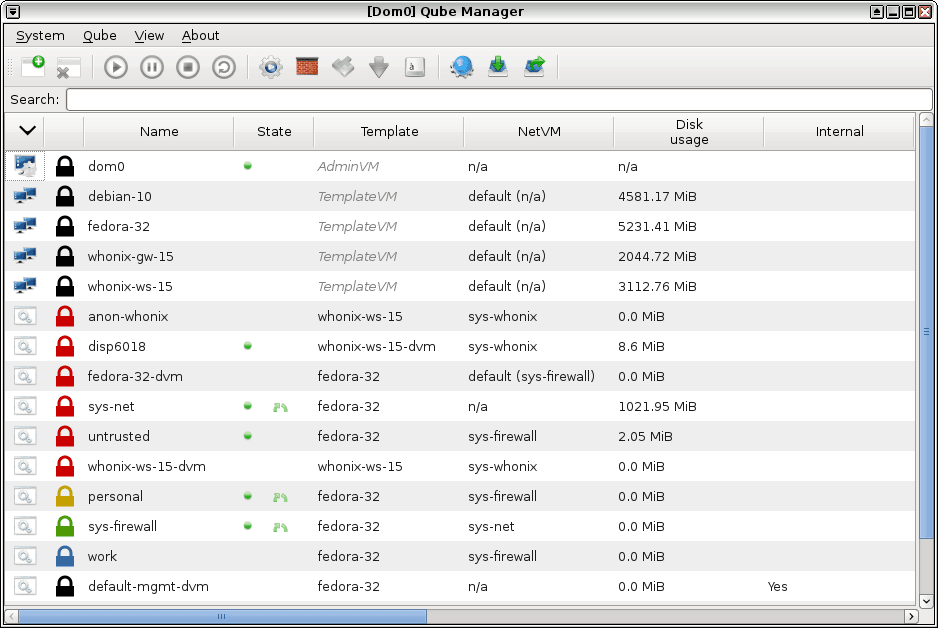
This security requirement comes with trade-offs, however. Qubes OS requires recent hardware compatible with virtualisation, as well as a significant amount of memory to keep several domains active. It also involves a genuine learning curve, because security depends as much on the architecture as on the user’s discipline. Qubes OS is not a comfortable system by default, but an environment designed for people who put isolation and control above simplicity.
Qubes has a reputation as the ultimate secure operating system, recommended by Edward Snowden, researchers and organisations such as the Freedom of the Press Foundation. It has been presented at conferences and examined in academic analyses. Its design has been continuously audited by the community.
2. Tails, the amnesic operating system for anonymity
Tails is a system designed to disappear without leaving a trace. It runs exclusively in live mode from a USB drive and is never installed on the host machine. Every time it is shut down, the entire session is erased, preventing any later recovery of data, history or activity traces. This so-called amnesic design protects against forensic analysis and persistent compromise when the computer being used cannot be trusted.
All network traffic is automatically forced through the Tor network. No application can communicate outside this tunnel, preventing IP-address or metadata leaks. The built-in tools are deliberately limited and configured by default to greatly reduce human error.
In practice, Tails is suited to occasional anonymous sessions on untrusted hardware. It lets you work from a public or borrowed computer, or one that may be compromised, without exposing your personal data or identity. This makes it a preferred tool in sensitive situations where the priority is leaving no trace after use.

 assistouest.fr
The NSA itself reportedly described Tails as a major threat to its surveillance capabilities. The OS gained worldwide recognition when Edward Snowden used it in 2013 to communicate discreetly with journalists (Laura Poitras and Glenn Greenwald) during the revelations about the NSA. Since then, Tails has been recommended by many NGOs, journalists, activists and whistleblowers as an essential tool for secure communication. It is partly funded by the Tor Project and organisations promoting digital freedom, and is regularly subjected to public security audits.
3. OpenBSD, proactive security in a minimalist Unix system
OpenBSD is often cited as the benchmark for Unix security because security is part of the system’s DNA. The project was launched with the goal of building a secure-by-default OS by reducing the attack surface as much as possible, disabling all unnecessary services and conducting systematic code audits to eliminate errors before they become exploitable vulnerabilities. Every component is scrutinised module by module for safety, and protections such as strict privilege separation, package trust-chain verification and advanced memory mechanisms are built into the core of the system.
The system leaves no port open, enables a firewall by default and includes memory protections that prevent pages from being both writable and executable, along with address randomisation to counter classic exploits. These features are part of its foundations. In practice, this means a reduced attack surface, more predictable process behaviour and less reliance on manual configuration to achieve a high level of security.
The developers have even created safe functions to replace risky C constructs and integrated cryptographic primitives directly into the kernel and system environment. The team applies patches very quickly to confirmed vulnerabilities, and the project remains faithful to its original vision of proactive security rather than a reactive approach. All of this makes OpenBSD a preferred system for environments where resilience against attacks is a fundamental requirement.
4. Whonix, network compartmentalisation in a virtual machine
Whonix separates the working environment from network access to eliminate identity leaks at the source. The system is structured around two distinct environments: one dedicated exclusively to connecting to the Tor network, and the other to the user’s applications. This architecture prevents any direct communication with the Internet outside the Tor tunnel and makes anonymity a structural constraint.
This approach provides particularly robust protection against human error and malware seeking to reveal a real IP address. Applications run in an environment that knows nothing about the outside network, while the Tor gateway acts as a strict, non-bypassable filter. Even malware with elevated privileges remains trapped in a perimeter where it cannot identify the host machine or the user. Whonix does not promise absolute invisibility, but it makes accidental leaks extremely difficult.
Whonix is designed for continuous use and integrates easily into an existing environment, allowing you to work, communicate and browse while maintaining a high level of privacy. This combination of structural anonymity and continuity of use makes it a preferred tool for exposed users who need discretion every day.
What should you expect from a secure operating system?
A secure operating system is neither invulnerable nor free of flaws. It is designed on the assumption that an attack is inevitable. The central question is therefore not whether a vulnerability exists, but whether it can produce lasting effects. A genuinely secure system primarily seeks to reduce opportunities for attack and prevent a local error from becoming a total compromise.
The first expectation is a reduced attack surface. A secure OS must limit active services, exposed components and code running with elevated privileges to what is strictly necessary. The fewer features there are, the fewer exploitable entry points exist. This restraint is a design choice intended to make the system more predictable and easier to control.
Isolation and process compartmentalisation
Applications must be confined to perimeters with no access to the rest of the system, sensitive data or the network. When software is compromised, the system must be able to contain the incident, limit the damage and prevent any spread. Security relies on the strict separation of responsibilities and privileges.
A secure operating system must also be resilient against modern exploitation techniques. Most attacks target memory and execution mechanisms. An OS is therefore expected to natively integrate protections that make these attacks complex, unstable and costly, making exploitation unpredictable and difficult to automate.
Resistance to persistence
An attacker rarely seeks one-off access; they seek a lasting presence. A secure OS must protect its critical components, verify its integrity at startup and prevent the silent installation of persistence mechanisms. It must also allow a rapid return to a healthy state when there is doubt.

Security also concerns the network, and a worthy operating system adopts a restrictive posture by default, limiting unnecessary communications and avoiding any default trust in the network environment. Traffic must be controlled and accidental leaks made difficult so that the system does not itself become a vector of exposure.
A secure OS must account for the human factor
Human error is inevitable, and the system must be designed to absorb it rather than amplify it. Default choices should be cautious, sensitive actions clearly identified and dangerous behaviours difficult to perform without explicit intent. Security must not depend solely on user vigilance, but on a defensive architecture maintained over time.
We allow some readers to view our articles for free with an ad blocker. However, their number is currently too high for us to keep this access available to everyone.
You can disable your ad blocker to continue reading immediately, subscribe to enjoy all our content without ads, or come back a little later when the pressure has eased.
Access will be restored automatically as soon as the situation allows.